
Aftir Logo AFTIR
Home Search Archive About Login
Aftir is now available wherever you are. Create free memorials for family, friends, and pets on the web, Android, or iPhone.
Create Your Free Account
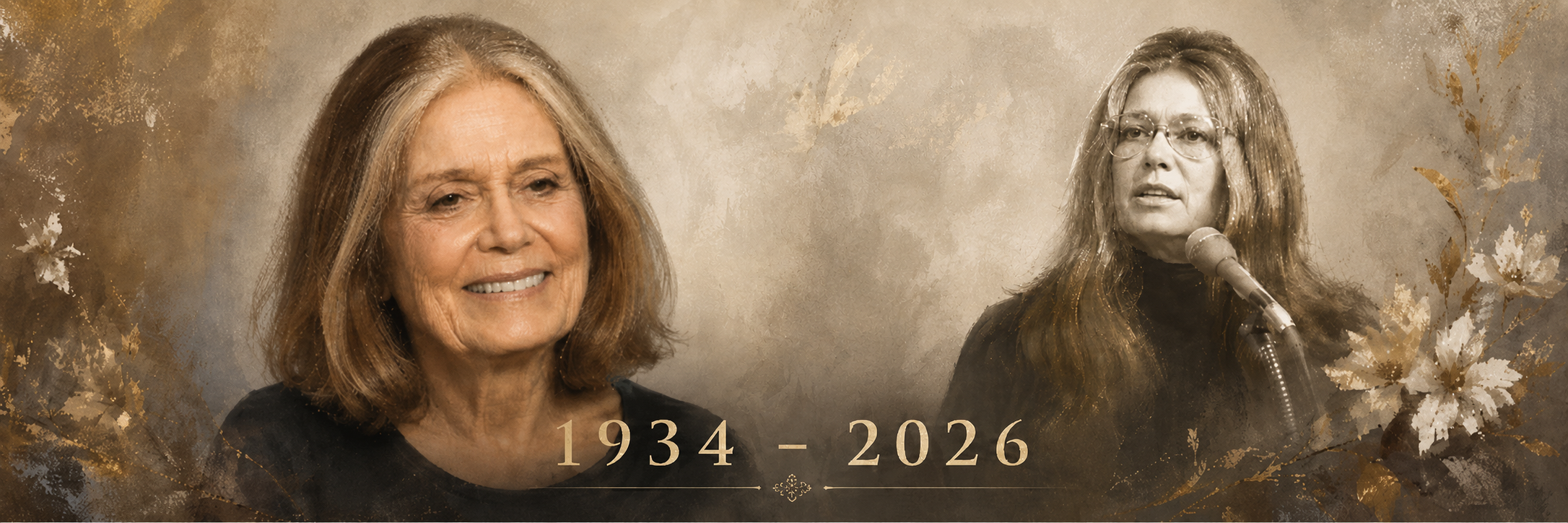
Gloria Steinem memorial banner

Gloria Steinem

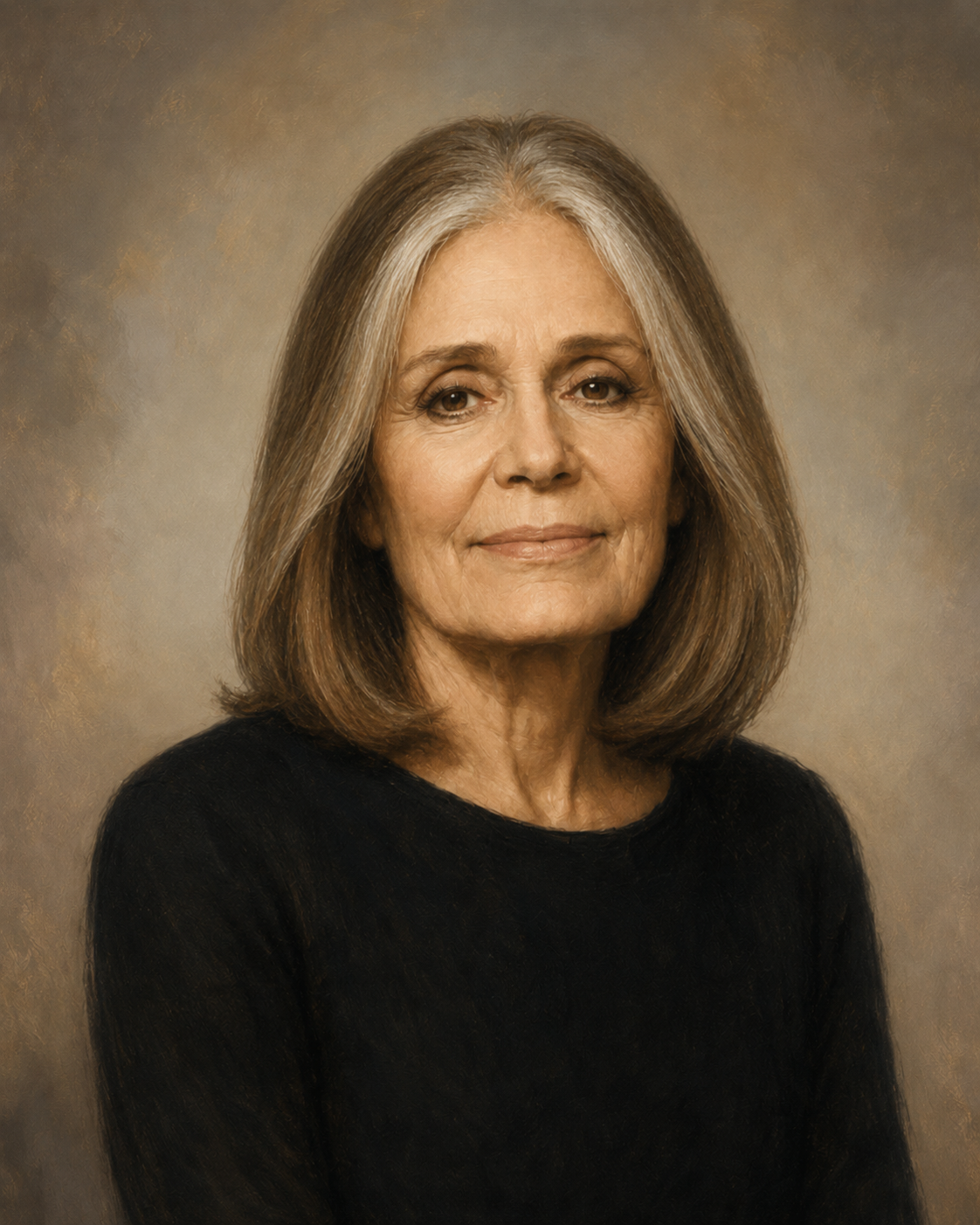
Gloria Steinem memorial portrait

Journalist/Activist
Born March 25, 1934 — Passed September 2, 2026

Gloria Marie Steinem was born on March 25, 1934, in Toledo, Ohio. Her childhood was unconventional and often unsettled, with frequent travel and periods of financial difficulty. After her parents separated, she remained with her mother in Toledo and took on significant responsibilities at a young age. She later moved to Washington, D.C., completed high school, and attended Smith College, graduating in 1956 with a degree in government.

A Chester Bowles Fellowship took her to India for two years after college. There she traveled extensively and encountered grassroots organizing influenced by Mahatma Gandhi. The experience helped shape her lifelong belief that lasting social change depended less on individual leaders than on people organizing, listening to one another, and acting collectively.

After returning to the United States, Steinem pursued journalism in New York at a time when women were routinely steered away from political and public-affairs reporting. She gained national attention in 1963 by going undercover as a Playboy Bunny and documenting low pay, sexual pressure, and restrictive working conditions. The assignment made her widely known, although she later said it temporarily made it more difficult to be taken seriously as a journalist.

In 1968 Steinem helped launch New York magazine and became a political columnist. Her reporting increasingly focused on civil rights, politics, and the emerging women's movement. Her 1969 essay “After Black Power, Women’s Liberation” brought further attention, and that same year an abortion speak-out in New York became a turning point in her life. Steinem had obtained an abortion in London at age 22, and hearing other women speak publicly about similar experiences helped move her from observer to active feminist organizer.

Although initially uncomfortable with public speaking, Steinem became one of the movement's most visible voices, often appearing with activist Dorothy Pitman Hughes. She emphasized that sexism, racism, poverty, and other forms of inequality were interconnected and repeatedly resisted the idea that feminism should be centered on a single leader.

In 1971 she joined Shirley Chisholm, Bella Abzug, Betty Friedan, Fannie Lou Hamer, and others in founding the National Women's Political Caucus to increase women's participation in political life. She also helped establish the Women's Action Alliance. Around the same time, Steinem and other feminist journalists created Ms. magazine. A preview issue appeared in 1971, followed by regular publication in 1972. The magazine brought sustained attention to subjects such as abortion, domestic violence, workplace discrimination, sexual harassment, childcare, and women's political power.

Steinem remained an editor at Ms. for roughly fifteen years and stayed associated with the magazine throughout her life. She helped found the Ms. Foundation for Women in 1973 and later co-founded organizations including Voters for Choice and the Women's Media Center, created in 2005 with Jane Fonda and Robin Morgan to increase women's visibility and influence in media.

Her books and essays extended the same themes. Outrageous Acts and Everyday Rebellions collected decades of writing on gender and power; Revolution from Within explored self-esteem and social change; Moving Beyond Words examined assumptions about gender and identity; and her 2015 memoir My Life on the Road reflected on decades of travel, organizing, and listening to people across the country.

Steinem chose not to have children and often described that as one of the choices women should be free to make. At 66, after many years of criticizing the unequal legal structure of traditional marriage, she married British businessman and activist David Bale in 2000. She said the decision reflected how much marriage itself had changed through legal and social reform. Bale died in 2003 after developing brain lymphoma.

Steinem remained active into her later years, advocating for reproductive freedom, women's political representation, racial equality, LGBTQ+ rights, and opposition to gender-based violence. President Barack Obama awarded her the Presidential Medal of Freedom in 2013. At age 82 she addressed the 2017 Women's March in Washington, and she continued writing and meeting with organizers into her 90s.

Her final memoir, An Unexpected Life, was completed shortly before her death and scheduled for publication later in September 2026. Gloria Steinem died peacefully at her home in New York City on September 2, 2026, at age 92. Her foundation said she remained engaged in the work of equality until the end. No specific cause of death was publicly announced.

Famous For

Gloria Steinem was most widely known as one of the defining public figures of the modern American women's movement. Through journalism, organizing, public speaking and institution-building, she helped bring questions of reproductive freedom, workplace equality, domestic violence, political representation and gender roles into mainstream American debate.

She was particularly associated with the creation of Ms. magazine and with the second wave of feminism that emerged nationally in the late 1960s and 1970s. Her distinctive public image made her unusually recognizable for an activist, but she repeatedly resisted the idea that feminism belonged to a single leader and emphasized that social movements were built collectively. 

Roles / Teams / Organizations

  • Journalist and freelance writer — began professional journalism in the late 1950s and early 1960s.
  • New York magazine — helped found the magazine in 1968; political columnist and feature writer.
  • Ms. magazine — co-founder; preview issue launched in 1971 and regular publication began in 1972; editor for approximately fifteen years and later consulting editor.
  • National Women's Political Caucus — co-founder, 1971.
  • Women's Action Alliance — co-founder, 1971.
  • Ms. Foundation for Women — founding member, 1973.
  • Voters for Choice — co-founder of the reproductive-rights political organization, established in the 1970s.
  • Women's Media Center — co-founder with Jane Fonda and Robin Morgan, 2005.
  • Women's-rights and social-justice organizer and lecturer — worked nationally and internationally for more than six decades.
  • Presidential Medal of Freedom recipient — 2013.
  • American Academy of Arts and Sciences — elected member, 2025.
  • Significant Contributions

    Steinem's most consequential contribution was helping transform feminism from a collection of local organizations and campaigns into a national public conversation. She understood journalism as a form of organizing: stories could allow women to recognize that experiences they had regarded as private problems—unequal pay, domestic violence, sexual harassment, restricted reproductive choices or discrimination at work—were shared social and political issues.

    Ms. magazine created an enduring national platform for that conversation. Its early success demonstrated an audience for journalism that treated women as readers interested in politics, economics, health, law and culture rather than only domestic subjects. The magazine reported on subjects such as domestic abuse and sexual harassment years before many mainstream publications regularly addressed them.

    Steinem also helped convert ideas into institutions. The National Women's Political Caucus worked to increase the number of women in elected and appointed office; the Ms. Foundation directed resources toward organizations led by women; and the Women's Media Center challenged women's underrepresentation as journalists, experts, decision-makers and subjects of news coverage. Those institutions gave parts of the movement organizational permanence beyond Steinem's own public career.

    Notable Works

  • Undercover Playboy Club exposé (1963) — Steinem worked as a Playboy Bunny to document working conditions, low pay and sexual pressures. The series became widely known as A Bunny's Tale.
  • “After Black Power, Women's Liberation” (1969) — an influential essay connecting the emerging women's movement with broader struggles against discrimination.
  • Ms. magazine (1971–72 onward) — the publication she co-founded became one of the defining institutions of American feminist journalism.
  • “If Men Could Menstruate” (1978) — a satirical essay reversing gender roles to examine how power influences attitudes toward biology and menstruation.
  • Outrageous Acts and Everyday Rebellions (1983) — a major collection of Steinem's essays and journalism.
  • Marilyn: Norma Jeane (1986) — her examination of Marilyn Monroe's life, accompanied by photographs by George Barris.
  • Revolution from Within: A Book of Self-Esteem (1992) — explored the relationship between personal identity, self-worth and social structures.
  • Moving Beyond Words (1994) — essays challenging assumptions about gender, politics, power and culture.
  • My Life on the Road (2015) — a memoir centered on travel, listening, activism and the people Steinem encountered during decades of organizing.
  • An Unexpected Life (2026) — her final memoir, completed before her death and scheduled for posthumous publication on September 22, 2026.
  • Famous Quotes

  • “Whatever the question...women are part of the answer.”
  • “The means are the ends.”
  • “Imagining is the first step to creating.”
  • Cultural Impact

    Gloria Steinem helped change what Americans were willing to discuss publicly. Subjects such as abortion, sexual harassment, domestic violence, workplace discrimination, reproductive freedom, and unequal political representation had often been treated as private matters or relegated to narrowly defined “women’s issues.” Through journalism, organizing, and public speaking, Steinem helped move them into mainstream political and cultural debate.

    Her influence was also institutional. Ms. magazine gave feminist journalism a lasting national platform, while organizations she helped establish supported women’s political participation, philanthropy, reproductive rights, and representation in the media. Those institutions allowed ideas associated with the women’s movement to endure beyond individual campaigns and personalities.

    Steinem also helped broaden the public understanding of feminism itself. She consistently argued that gender inequality could not be separated from racism, economic inequality, sexuality, and other forms of discrimination. She frequently credited Black women and other grassroots organizers with shaping her own thinking and resisted efforts to define feminism around a single spokesperson.

    By the end of her life, many ideas that were considered radical when she began her work had become ordinary expectations for millions of people: that women should control their own finances, participate fully in politics and the workplace, make decisions about their own bodies, and define lives outside traditional expectations of marriage and motherhood. Her cultural impact lay not only in advocating those ideas, but in helping make them part of the normal vocabulary of American public life.

    Lesser-Known Stories

  • She once thought dancing might be her way into a different life. As a girl in Toledo, Steinem became a skilled tap dancer and for a time imagined that performing might be her path beyond the instability of her childhood. The ambition faded, but it reflected an early desire to make a life on her own terms.
  • Her most famous early reporting assignment became a professional burden. Steinem’s 1963 undercover investigation of the Playboy Club made her nationally recognizable, but she later said editors often reduced her to “the Bunny story” afterward. The assignment exposed exploitative working conditions, yet for a time it made it harder for her to receive serious political and investigative assignments.
  • Public speaking did not come naturally to her. Despite eventually becoming one of the most recognizable speakers in the women’s movement, Steinem was initially frightened of speaking before audiences. She turned to public appearances partly because the stories she wanted to tell about the movement were not receiving enough space in print.
  • Sources / Notes

  • Associated Press — apnews.com
  • Reuters — reuters.com
  • Gloria's Foundation — gloriasfoundation.org
  • Ms. Magazine — msmagazine.com
  • Ms. Foundation for Women — forwomen.org
  • National Women's History Museum — womenshistory.org
  • Smith College — smith.edu
  • National Women's Political Caucus — nwpc.org
  • Women's Media Center — womensmediacenter.com
  • Obama White House Archives — obamawhitehouse.archives.gov
  • American Academy of Arts and Sciences — amacad.org
  • Penguin Random House — penguinrandomhouse.com
  • Tribute created with love by Aftir

    Light a Candle

    8 people have lit a candle in remembrance.

    Memories Shared

    No public memories have been approved yet.

    Share a Memory

    Leave a memory, message, or reflection in honor of Gloria Steinem.

    Share Memorial

    Memorial Information

    This memorial page was created to preserve and share the life, memories, stories, photographs, and legacy of Gloria Steinem. Friends, coworkers, loved ones, and others who knew Gloria Steinem may contribute memories and reflections that help celebrate a life that continues to be remembered.